- Observability 360
- Posts
- Agentic Platforms - the New Frontier
Agentic Platforms - the New Frontier
We're All Plugin Developers Now | Honeycomb At Ten

John Hayes
March 06, 2026

Welcome to Edition #43 of the Newsletter!

Image courtesy of deezen.com
The AI revolution continues to unfold at breakneck pace. It seems though, that whilst some technologies quietly embed themselves in the tooling and become invisible, AI also has the potential to make us active collaborators in the tooling we are using.
Like a Richard Rogers building, the plumbing is on the outside. As we discuss in our New Relic piece below, the application UI is no longer just a window, it is now a foundry where we are able to not just customise a vendor UI, but actually re-engineer it to meet our own business needs. This is a really exciting development that kind of flips the narrative of AI de-skilling.
We think this is the next frontier for vendors - not just building observability platforms, but also enabling users to use agentic AI to extend those platforms.
Feedback
We love to hear your feedback. Let us know how we are doing at:
NEWS
New Relic Roll Out Agentic Platform

Whilst many vendors have now embedded AI agents into their platforms, others, such as Elastic and OpenSearch, have upped the ante by providing tooling for agent creation.
This is a model that offers incredible potential for customers to gain value from AI-driven platform customisation. It was inevitable that other vendors would follow suit and now New Relic have unveiled their own Agent Platform - which they describe as a “no code solution to build and govern custom AI Observability Agents at scale”.
According to New Relic, domain experts will be able to build agents to reduce toil and gain deeper insights into distributed systems. The no-code philosophy aims to democratise access to AI tooling as well as helping companies overcome the AI skills gap.
We think this will rapidly become a must-have feature that will be incorporated into every major observability platform.
SquaredUp - Let a Thousand Plugins Bloom

SquaredUp are a leader in the data visualisation and Operational Intelligence sector and have recently announced a major new initiative enabling engineering teams to roll their own plugins for any web API.
The Low Code Plugins (LCP) framework takes care of all the scaffolding, enabling users to develop their own plugins with a minimum level of coding effort.
The framework will take care of building the underlying infrastructure for connectivity, authentication, paging, and rendering the UI. As an initial step the company have released a tranche of 16 plugins which have been developed using the framework. These have been released as open source on GitHub.
This will be followed by the full release of the framework where users can build their own plugins and share them with the wider community.
VictoriaMetrics Get Logged On

It seems like VictoriaMetrics are a company that really has their pedal to the metal at the moment. It was recently revealed that OpenAI use VM as the backend for their Codex metrics and the company have now also announced a new release which sees VictoriaLogs going GA in the company’s cloud offering.
The VictoriaLogs service has been available in the open source tier for some time and in company have also built an open source tracing solution as they edge inevitably towards a full stack managed observability platform.
The latest release is not just about logs though. VM are also leaders in tackling one of the hard problems in observability - anomaly detection. The company’s vanomaly product (only available to enterprise users) continues to be a market leader. You can find all the latest updates on vanomaly here.
Catchpoint State of SRE - the Bar Keeps on Rising

There are many “state of” reports but the Catchpoint survey still stands out as one of the most incisive and grounded. Whereas some surveys seem designed to highlight numbers that suit a particular vendor’s agenda, the Catchpoint report offers deeper and more reflective insights into the nature of SRE practice. It somehow seems more informed by the day-to-day experiences of professionals at the sharp end.
We are all familiar with the aphorism that “Slow is the new down”, this year’s survey reconstructs this notion into the formula that “speed is the new trust” - even arguing that speed is actually the “cornerstone of any modern digital business strategy“. For SREs though, what this means is having to respond to ever more demanding targets.
The value of these reports lies very much in asking the right questions, and Catchpoint seem to be genuinely in tune with the concerns of SRE practitioners. As well as covering obvious questions such as AI adoption there are also deeper investigations into the alignment of management with SRE as well as perceptions of the language of reliability itself.
Products
Hud - Game On for Agentic Observability

It is maybe paradoxical that we are heading into a new era of software being created by AI agents, yet we are still reliant on industrial-era signals such as logs, metrics and traces. Well, cometh the hour, cometh the Hud - a product which dispenses with the traditional three pillars approach and instead is built around a “runtime code sensor”.
Getting started is similar to using a product such as Sentry - you initialise an SDK which hooks into an application’s runtime. However, this is a lot more than sprinkling some AI glitter onto a debugging UI. Hud is built from the ground up to embed itself into - and help drive - the agentic coding cycle. It builds up rich context and provides a continuous stream of on-screen intelligence.
Things are moving so fast at the moment that it is not easy to “position” a tool such as Hud. Is it in the inner loop or is it in the outer loop or is it in a new space where both of those loops have been dissolved into a new agentic coding cycle?
Eyers on the Prize

One of the fundamental characteristics of observability is the transition from a reactive to a proactive posture. This is a cultural change, but also one which requires the right tooling. Eyer is a product designed to assist teams on this mission through AI-driven anomaly detection.
Like many similar tools, Eyer is headless and designed to integrate into your enterprise architecture by exposing an API which you can connect to with tools such as Slack and Grafana. Eyer also ships with an MCP server so you can run natural language queries on your data.
Interestingly, as well as plugging into your metrics pipeline, Eyer can also build additional context by ingesting documents, KPIs and other types of data. The company say that the product can reduce alert noise by up to 85%.
From the Blogosphere
Honeycomb - 10 Years in the Vanguard

Honeycomb are celebrating their tenth birthday this year and, perhaps fittingly for a company whose thought leadership has shaped both the narratives and the practice of observability, they are marking the occasion by unveiling a manifesto for the next decade (and beyond).
This article reflects on Honeycomb’s origins and reaffirms the technological and theoretical principles on which the company was founded - most notably a rejection of the siloed three pillars model and the firm conviction that only data structures that embody multi-dimensional context would be capable of providing answers to the unknown unknowns.
The manifesto itself consists of nine statements which attempt to identify the trends emerging from the current AI firestorm and distil some truths about the nature of observability practice in the brave new world ahead.
Birthday Bonus! This article also includes a link for a free download of the seminal Observability Engineering e-book published by O’Reilly.
Continuous Profiling in Production
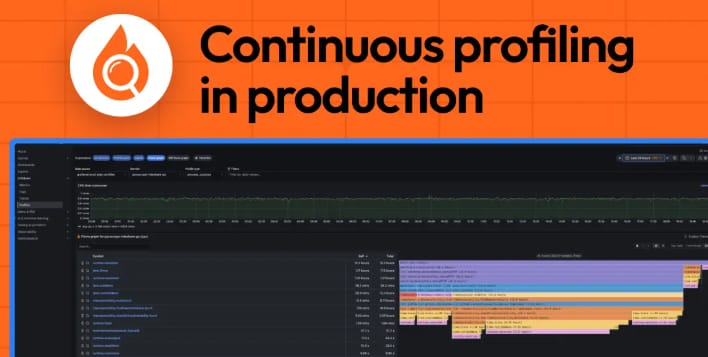
Sometimes, when you really want to push the needle on performance, you need more depth and granularity than can be found in standard time series metrics. This is where continuous profiling comes into play, as it drills down into the application runtime to measure performance at the code level.
Amassing highly granular telemetry can incur a significant resource footprint - not to mention ingestion and storage costs for the generated telemetry.
Jake Kramer is a member of the engineering team for Pyroscope - a profiling product acquired by Grafana in 2023. In this article on the Grafana blog he shares a range of metrics on the resource overhead involved in continuous profiling (it’s not as hefty as you might think). He also compares performance across a number of different runtimes, assesses different workload types and looks at backend and storage costs.
AI
Getting on the Claudit Trail - Harnessing Claude Code’s oTel Support

Your team is using Claude code - but did you know that Claude emits oTel telemetry so that you can go beyond the default metrics in the Claude console?
In this How-To article on the BindPlane blog, Adnan Rahic gives a quick primer on instrumenting Claude to deliver deeper insights to support auditing, governance and cost control.
Claude Sonnet and Opus 4.6 - what do the experts think?

Social media is awash with hot takes (and no little hype) about Anthropic’s latest release of their frontier models - Opus and Sonnet.
Resolve AI are leaders in the hyper-competitive AI SRE space, so when they published a brace of articles giving their early impressions of the models we definitely sat up and took notice.
In this article, Resolve technical staff members Murali Balusu and Vasanth Balakrishnan run the rule over Sonnet 4.6 - paying particular attention to the new adaptive thinking feature. This means that the model itself decides how deeply to reason - which is a crucial ability in complex and unpredictable systems.
In this companion article, meanwhile, Vamsi Bedapudi and Rushin Shah share their initial thoughts on Opus 4.6. On the basis of their findings, there are some really significant wins, including better handling of async tooling, longer attention spans and greater thoroughness in task completion.
OpenTelemetry
OpenTelemetry Unplugged - the Big Conversation

At last month’s OpenTelemetry Unplugged event in Brussels, CNCF Ambassador Dotan Horovits caught up with OpenTelemetry Governance Committee member Juraci Paixão Kröhling for a fireside chat. This record of their conversation makes for a great summary of the current state of play in the OpenTelemetry field.
One of our favourite takeaways from the discussion is Juraci's thoughts on vendors turning their custom versions of the oTel collector into lockin traps: “if your collectors are tied to a specific backend, it’s not OpenTelemetry anymore — it’s just telemetry”.
This is a wide-ranging conversation that covers many really hot topics. Another particular highlight was the discussion around Blueprints - opinionated playbooks for implementing OpenTelemetry in specific scenarios. Check out the article for further insights on key themes such as browser observability, semantic conventions and the end-user experience.
Social Media

Have we descended into the dead internet abyss or do there still exist brave outposts of human dialogue in cyberspace? No offence is inttended to any OpenClaw bots that may be reading this.
First is up is this Reddit post by cloudruler-io. - it is a really great reminder that observability is not a one-size-fits-all proposition. It is also a great reminder that in large organisations, scale is not the only issue - there is also the challenge of running a large number of heterogeneous systems - both in-house and third-party

This post by reddit user arbiter_rise probably reflects a concern being felt by observability professionals in almost every organisation - how do we deal with the challenge of LLM observability and gain visibility not just of outputs but of overall LLM behaviour.

That’s all for this edition!
If you have friends or colleagues who may be interested in subscribing to the newsletter, then please share this link!
I don’t know who the original author of this wonderful quote is, but it was referenced in this LinkedIn post by Juraci Paixão Kröhling:
“I only trust benchmarks I faked myself”
About Observability 360
Hi! I’m John Hayes - as well as publishing the Observability 360 newsletter, I am also an Observability Advocate at SquaredUp.
The Observability 360 newsletter is an entirely independent entity. All opinions expressed in the newsletter are my own.