- Observability 360
- Posts
- Buy, buy, buy!


Welcome to Edition #39 of the newsletter!
There appears to have been something of a buying spree in the observability market recently, with Chronosphere, ClickHouse and Embrace all involved in acquisitions. One driver for this is that observability is about system knowledge. As technology progresses there will be more systems and more knowledge we need to acquire.
At the beginning of the 20th century, many mathematicians subscribed to the theory that “ignoramus at ignoramibus” - we are ignorant and shall remain ignorant. By contrast, David Hilbert argued “there is no ignoramibus”.
In observability we may not be trying to prove the Riemann hypothesis, but Hilbert’s rallying cry may also be a fitting description of the trajectory of the discipline - developing tooling to provide ever greater understanding of an ever greater number of increasingly complex systems. And with increasing complexity, of course, comes increasing entropy. We will never have omniscience but, paradoxically, there will always be a demand for it.
Feedback
We love to hear your feedback. Let us know how we are doing at:
NEWS
Chronosphere Acquired by Palo Alto Networks
In a move that came as a something of a bolt from the blue, Chronosphere announced last week that they are to be acquired by cybersecurity giants Palo Alto Networks. Since its inception Chronosphere has raised $369m in funding and was valued at $1.6bn in 2023. You would expect therefore, that Palo Alto see this as a strategic move and not merely a hopeful punt.
This is a move that has a simple but also quite compelling logic. Observability systems gather vast volumes of structured data. Companies, such as Palo Alto, can achieve RoI on their AI investment and achieve synergies by unlocking value from that data.
In an interview with Bloomberg, Palo Alto CEO Nikesh Arora also revealed that Chronosphere appeared on his radar when the company were looking to acquire a player in the pipelining sector. In that respect, Chronosphere’s acquisition of Calyptia last year would certainly have increased their attractiveness as an acquisition target.
KubeCon North America Observability Day

KubeCon is really proving to be a great showcase for observability technology. The co-located Observability Day consisted of no less than 29 talks. Topics ranged from Open Source Column Stores to the Life of a Mobile Span. The ideal superpower for anyone attending KubeCon is the ability to be in two places at once as, running concurrently with Observability Day was CiliumCon, which included a session by Isovalent co-founder Thomas Graf, looking back on 10 years of Cilium.
In addition to the Observability Day event there were a further 20 observability-related talks over the three days of the event proper. Videos of all the talks from KubeCon are now available on the CNCF YouTube channel. That amounts to no less than 384 videos.
To help you avoid scroll fatigue, we will just mention a few that really caught our eye. There's a Lot of Bad Telemetry Out There by Dan Gomez Blanco and Juraci Paixão Kröhling contains some great object lessons in instrumentation. Next up is this brilliant defence of logs as a first class telemetry citizen by Robert Pajak.
But if there was one presentation that really knocked us out it was this virtuoso display of using MCP to talk to Perses dashboards by Prashant Gupta and Raj Bhensadadia from Apple.
Chronosphere Launch Composable Observability Partner Program
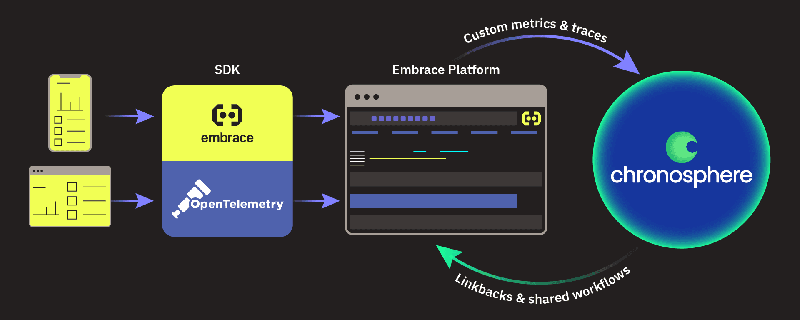
Composable observability is a highly seductive concept. The idea is that rather than buying a monolithic system from a single vendor, you build your own observability stack by assembling specialist systems from multiple vendors. It is a concept that has been championed by Grafana but lately Chronosphere have also struck out in this direction with a strategic Partner Program initiative.
The initiative involves orchestrating integrations with vendors such as Arize, Checkly, Embrace, Polar Signals, and Rootly to build an ecosystem encompassing domains such as LLM Monitoring, Real User Monitoring, Synthetics, Incident Response, and Profiling. This is a really exciting development if it can genuinely pull of the challenge of creating a single, seamless and unified experience for the end user.
ClickHouse Acquire LibreChat
Over the past year or so, ClickHouse have completed two major acquisitions to strengthen and extend their position across a number of fronts. The acquisition of PeerDB facilitated the use of the ClickHouse DB Engine as a large scale analytics layer sitting behind a transactional database such as Postgres. With the acquisition of HyperDX the company made their long-anticipated entry into the observability space.
The latest acquisition is LibreChat - an open source AI chat platform similar to ChatGPT. Bringing LibreChat into the mix will enable ClickHouse to accelerate their vision of a future where AI agents are the primary source of database queries. For customers, the ability to use LibreChat as the natural language interface to these agents can alleviate concerns around governance and data residency.
Embrace get ahead of the performance curve
It has been a busy month for Embrace. As well as joining in with the Chronosphere Partner Program they have also announced the acquisition of web performance specialists SpeedCurve.
Embrace built up their mobile observability product with an obsessive focus on the individual user experience. With their recently launched RUM product they have brought the same approach to the web. The acquisition of SpeedCurve brings a huge bank of expertise as well as one of the most advanced and in-depth web performance analytics products on the market.
Products
Sentry - The Metrics Reloaded
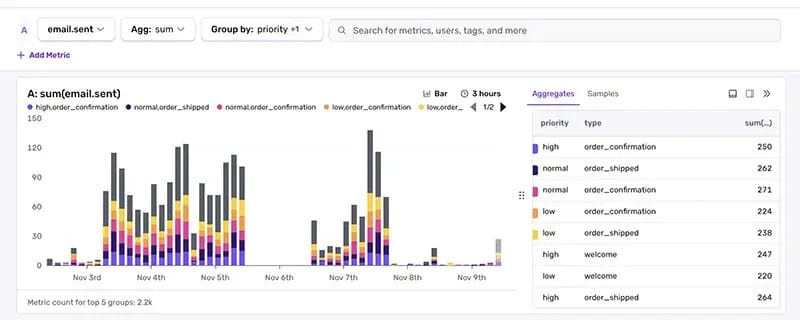
Some of the most instructive stories in tech are not necessarily the accounts of glittering success. Sometimes the most valuable tales are those of misjudgement, dead-ends and abandoned projects. This refreshingly frank article on the Sentry blog recounts how the company spent two years developing a metrics module, realised they had got it wrong, ripped everything up and started again.
So what happened? Well, when they started dog-fooding the feature internally, they realised that developer metrics is not about collecting billions of data points and then trying to identify patterns. They therefore started again with the intent of generating contextually relevant metrics. If you want to experience the company’s vision of developer-friendly metrics, you can try out the open beta.
The fact that Sentry now support Logs and Metrics raises the existential question - are they now a ‘full-stack‘ observability platform? We would say that, as the field evolves, the term ‘full-stack‘ is becoming less and less serviceable. Maybe Sentry are now a developer observability platform that supports metrics.
Parseable Launch Cloud Offering

We first covered Parseable back in Edition 14 of the newsletter around 18 months ago. Their product is a full-stack open source system built on a bring-your-own-S3 storage architecture. This offered a number of benefits including speed, economy and data sovereignty.
Over the past year and a half, the the product has undergone both functional evolution as well as a total rebuild of its UI. The latest phase of its development sees the roll out of Parseable Cloud. The platform boasts a number of impressive capabilities such as anomaly detection, predictive analytics and natural language querying.
If you are interested in trying the product then get your skates on. The first hundred workspaces willz qualify for a free offer of 1TB data ingestion and up to 5TB of query scans per month.
Lawrence OSS: oTel Fleet Management (with a little help from Claude)
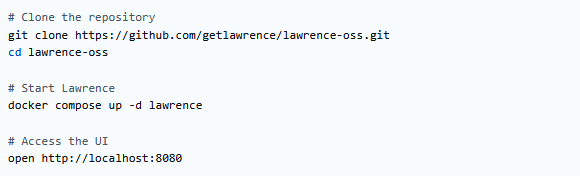
Fleet Management for oTel Collectors is turning into something of a market sector in its own right. The latest entrant into the space is Lawrence OSS, a platform which combines OpAmp functionality with an observability backend. It is a tool which seems to be designed with ease of use very much in mind and has a range of features to simplify managing your oTel Collectors.
It ships with a user-friendly UI to view workloads, edit configurations and visualise your telemetry pipelines. The software is open source and the GitHub page includes instructions for a quick start that runs the tool as a Docker container.
Whilst you’re on the GitHub page, you might want to check out an interesting inclusion in the list of project contributors:
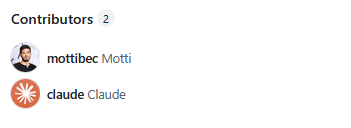
This Claude guy certainly seems to be putting in quite a shift at the moment.
Strategy
Everything You Ever Wanted To Know About Observability - in a Slide Deck

If the Observability world had a code of secrecy akin to that of the Magic Circle, then Charity Majors might be in danger of being banished to exile and ignominy. In a single slide deck, she has blown the gaff on a whole trove of insider knowledge. It is the “What they don’t teach you at Harvard Business School” of observability knowledge. Not the abstract theory or technical detail but lessons and insights from the o11y frontline.
The deck in question was used in a talk at the LeadDev event in Berlin earlier this month and its 52 slides are an illuminating distillation of observability wisdom. We actually weren’t present at the talk and only came across the deck thanks to a mention in Michael Hausenblas’s excellent olly news newsletter. However, the slides contain sufficient clues (and images of unicorns) to easily re-construct the narrative and win friends and influence people as an observability savant.
Blogosphere
An observability-driven development dojo with John Gallagher
There are a number of systems on the market that position themselves as being developer-focused. However, the value of these systems is greatly enhanced when developers also code with observability in mind. In principle, this is not too difficult. In practice though, there are a number of pitfalls which can result in low quality telemetry.
In this article on the Observability 360 web site, John Gallagher shares his tried and tested method for instrumenting your code to support subsequent diagnostics and troubleshooting. The code examples are in Ruby but the concepts will be familiar to pretty much anybody with coding experience.
The Ollys 2025
The Ollys 2025 - Be Part of it!
The Ollys are Observability 360’s annual awards for the observability space. They were launched two years ago and are the only awards dedicated to the observability field.
This year the awards will be running for the third time and, to keep things fresh, we have a few innovations up our sleeves. Observability is a dynamic and ever-changing space. We will therefore be retiring some of our existing categories and introducing some new ones. We will announce the full list of categories within the next few weeks.
As well as freshening up the format we would also love to include Observability 360 subscribers in the selection process. We are therefore opening up two categories to voting by readers of the newsletter. The categories will be:
Best presentation
Best observability blog
You can find more details on the categories and how to submit your vote on this page on the Observability 360 web site.
OpenTelemetry
oTel Gets More Expressive with Complex Attributes
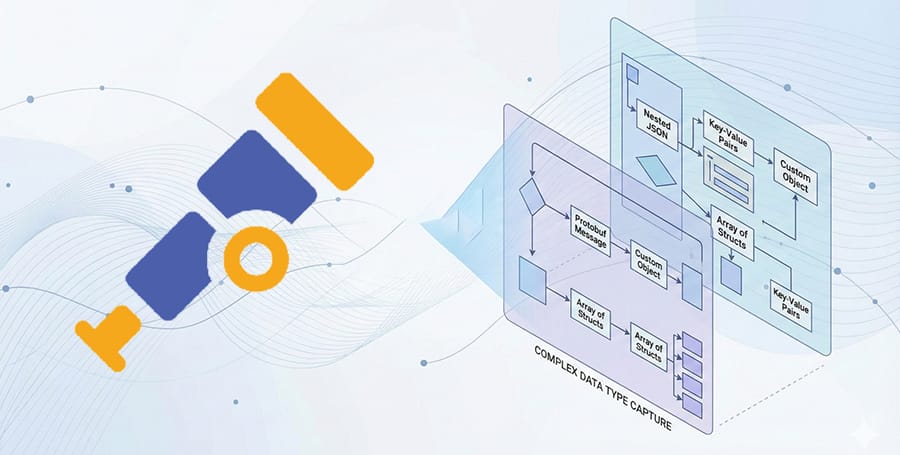
If you are a programmer, it is an unfortunate fact of life that reality has a habit of not always being reducible to name/value pairs. It insists on morphing, subdividing and being generally irregular and asymmetrical. This is the issue that OpenTelemetry engineers are seeking to tackle with the introduction of complex attributes.
The feature will be available from version 1.9.0 the OTLP specification and will mean support for complex types such as maps, heterogeneous arrays and byte arrays across all signal types.
Obviously, vendors will need to update their tooling to fully accommodate these changes as they will impact ingestion, storage and presentation in observability UIs.
That’s all for this edition!
If you have friends or colleagues who may be interested in subscribing to the newsletter, then please share this link!
This week’s quote is from Thomas Edison
“To have a great idea, have a lot of them”
About Observability 360
Hi! I’m John Hayes - I’m an observability specialist and I publish the Observability 360 newsletter. I am also an Observability Advocate at SquaredUp.
The Observability 360 newsletter is an entirely autonomous and independent entity. All opinions expressed in the newsletter are my own.